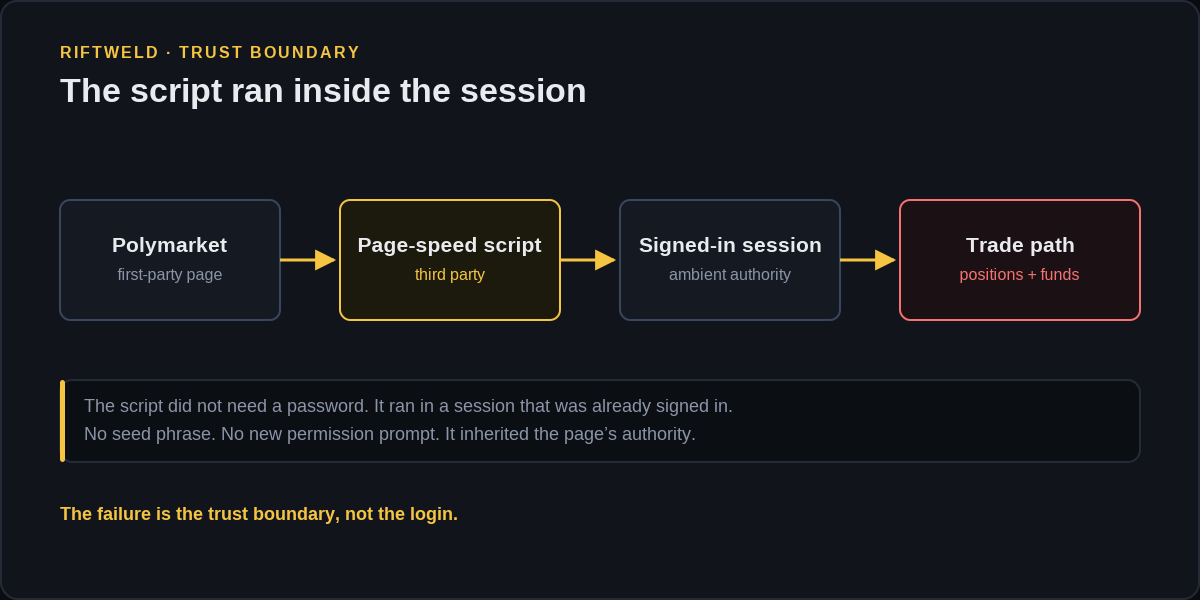
The script did not need a password. It ran inside a session that was already signed in.
That is the difference between a phishing page and a supply-chain compromise.
In this article
Why this matters
If your trading or banking frontend loads third-party JavaScript, that script runs with the authority of your page. On a signed-in session, that authority can include selling positions and moving funds. The login is not the boundary. The script slot is.
The dollar figure is small next to an exchange breach. The pattern is not. One substituted file in a page-speed slot, no new prompt, no seed phrase, no fake domain. The report describes the payload acting inside the trading session, which is exactly what a third-party script is allowed to do.
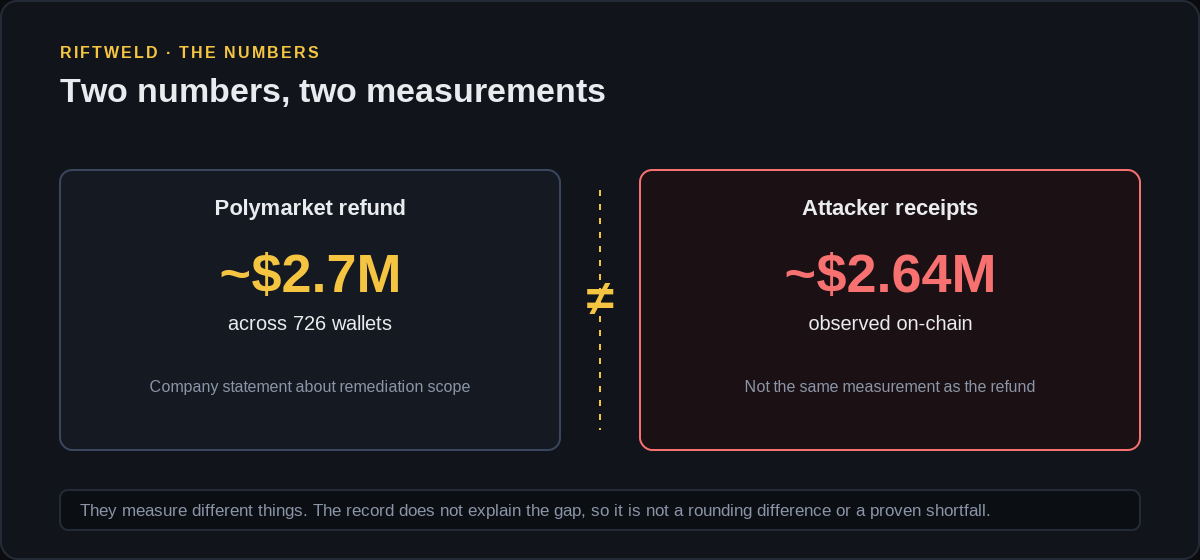
The two numbers matter as much as the mechanism. Polymarket's refund is a company statement about remediation scope. The attacker receipts are an on-chain observation. They are not the same measurement, and the record does not explain the gap. Treating either as the full loss figure is unsupported.
The record is also thin. It is a single secondary report, without a payload sample, script hash, malicious URL, transaction hashes, attacker wallet addresses, vendor statement or Polymarket postmortem. The pre-29 October window should be treated as unknown dwell time, not a known interval.
For defenders, the practical response is to inventory every script, pin content, restrict origins, instrument the transaction path, monitor outflows, require explicit confirmation for liquidations and bulk transfers, and keep a kill switch for each script origin.
What happened
On 29 October, a page-speed script loaded by Polymarket was replaced with malicious code and ran on the site in the browsers of some signed-in traders. The reported effect was that positions were sold and funds were transferred to the attackers (The Hacker News).
Polymarket says it is refunding approximately $2.7 million to 726 affected wallets. Separately, blockchain records show cryptocurrency worth approximately $2.64 million reaching the attackers (The Hacker News).
The report does not establish a time of day, an end time, or whether the malicious script was served once or repeatedly during the exposure window. The compromise of the third-party script and its substitution with malicious code necessarily preceded the activity, but no date is given for either event (The Hacker News).
The two financial figures measure different things. The first describes the company's stated remediation scope. The second describes observed attacker receipts. The report does not explain the difference, and it should not be characterized as either a rounding difference or a shortfall without further evidence (The Hacker News).
Where the trust boundary broke
The affected component was not Polymarket's on-chain contracts or a private-key store. It was the browser-side execution environment of the trading frontend, reached through a third-party JavaScript dependency (The Hacker News).
In a conventional web application, the origin server is the natural trust boundary. A third-party script breaks that assumption. Once a browser loads a script from an external host, that script executes with the ambient authority of the embedding page. It can read and modify the DOM, call application interfaces, and act on the authenticated session without crossing a separate permission prompt. The report describes exactly this outcome: code delivered through a page-speed script slot sold positions and moved funds for signed-in traders (The Hacker News).
The word "signed-in" is the operative detail. It indicates that the payload's capability was conditioned on an authenticated session rather than on a compromised credential store or a separately phished secret. In a web-wallet or exchange-frontend architecture, an authenticated session typically exposes the ability to construct, sign and broadcast transactions. A script running in that context can act as the trader without presenting a phishing page or requesting a seed phrase. The report does not state that private keys or seed material were exposed, and it does not describe a key-extraction step (The Hacker News).
The blast radius described is bounded by which wallets were signed in during the exposure window and which assets those wallets could move. The report does not state whether all 726 affected wallets were signed in during that window or were identified by another method, and it does not indicate whether any wallet was compromised through a second, independent vector (The Hacker News).
Two numbers, two measurements
The refund and the attacker receipts are often repeated as if they are the same number. They are not.
Dividing the reported refund total by the reported wallet count yields a derived average of roughly $3,700 per affected wallet; dividing the attacker-receipt total by the same count yields roughly $3,640 (The Hacker News). These are arithmetic derivations, not reported per-victim losses. The distribution is unknown: a small number of high-value wallets could account for most of the total, or losses could be broadly spread. The averages should not be used as planning figures for expected loss per compromised session.
The DebugBear attribution is weaker than the core incident description. It appears in the headline and summary rather than in a quoted technical finding within the report, and it has not been independently verified here (The Hacker News).
What the record supports
Confirmed by the report: malicious code ran on Polymarket's website; it replaced a third-party page-speed script; it sold positions belonging to some signed-in traders and moved their funds to the attackers; the activity occurred on 29 October; Polymarket stated that it is refunding about $2.7 million across 726 wallets; and blockchain records showed about $2.64 million in cryptocurrency reaching the attackers (The Hacker News).
Reported but not independently verifiable from the report: the attribution of the script hijack to DebugBear. That attribution appears in the headline and summary rather than in a quoted technical finding, forensic report or vendor statement included in the material (The Hacker News).
Unconfirmed or not established: the initial access vector into the third-party infrastructure, the identity of the operators, the exact payload behavior, the number of victims beyond the 726-wallet refund cohort, whether any funds were laundered or recovered, and whether the compromise persists (The Hacker News).
The report does not describe Polymarket's specific remediation beyond the stated refund. It does not report when the malicious script was removed, whether sessions were invalidated, or whether any law-enforcement or recovery action followed (The Hacker News).
What to do
Third-party script inventory and pinning. Enumerate every script loaded by trading frontends, record origin and version, and alert on changes to content hash, filename or delivery host. The core failure was that a legitimate script slot carried illegitimate code; content pinning would have surfaced the substitution directly.
Subresource integrity and CSP. Enforce integrity attributes on externally hosted scripts and restrict script-src to an explicit allowlist. These controls do not stop a compromised allowed origin, but they prevent an attacker from silently adding a new script host.
Transaction-intent telemetry. Log and alert on position sales and outbound transfers initiated from a browser session, particularly bulk or near-simultaneous activity across many accounts. The described attack required the payload to invoke the application's own transaction path, and that path is observable if instrumented.
On-chain monitoring. Track flows from Polymarket-related wallets to addresses not previously associated with the user, and flag sudden liquidation patterns. The reported $2.64 million reaching the attackers was visible in blockchain records, which demonstrates that the outbound leg is observable.
Vendor-side controls. For any organisation operating a script CDN, treat the distribution path as a production system: require signed artifacts, immutable versioning and out-of-band verification of releases. The report does not state which of these the vendor had or lacked, so this is a general control recommendation rather than a finding about the vendor.
For operators, the practical controls are to minimise third-party script count on transaction-critical pages, isolate signing and transaction construction from general page scripts, require explicit user confirmation for position liquidation and bulk transfers, and maintain a kill switch for individual script origins. The incident supports treating any script loaded on a financial frontend as part of that application's trusted computing base.
Sources
- Swati Khandelwal, "Hackers Steal About $2.7 Million From Polymarket Traders via Hijacked DebugBear Script," The Hacker News, November 1, 2026: https://thehackernews.com/2026/11/hackers-steal-about-27-million-from.html
- Riftweld Offensive Security Research Desk, "Polymarket DebugBear Supply-Chain Script Hijack: Operator Research Report," built exclusively from the headline, summary and metadata of the source above: https://thehackernews.com/2026/11/hackers-steal-about-27-million-from.html