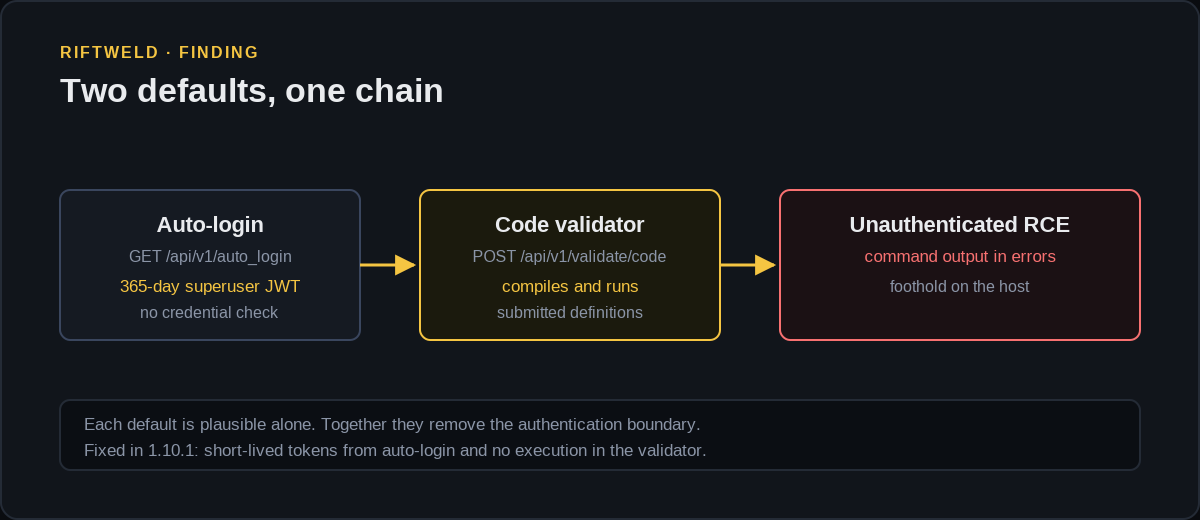
Langflow's default configuration handed out a superuser token without a credential check, and its code validator ran what it was given. One unauthenticated request was enough to turn that into command execution.
The fix had to close both halves. 1.10.1 did.
In this article
Why this matters
The chain is not one faulty line. It is two defaults that look reasonable on their own: an auto-login convenience for local deployments, and a validator that compiles submitted code to tell a user whether it works. Put together, they remove the authentication boundary entirely.
The first default gives an unauthenticated caller a 365-day superuser token. The second runs attacker-supplied code in the validation path and returns the output. Neither step asks who is calling.
This is why the bug reached CISA's Known Exploited Vulnerabilities catalogue. The defaults do the work for the attacker, and the exploit is a two-request chain rather than a bespoke exploit.
Exposure is not compromise. The unauthenticated path requires auto-login to be enabled, and we found at least one vulnerable-version deployment where it was not. Version triage is a lower bound; configuration decides whether the route is open.
For operators, the lesson is to treat default auto-login and code-execution validators as one combined risk. Auditing them separately misses the chain.
What we reproduced
The vulnerability was disclosed publicly by IBM and CISA, and recorded in NVD and the CVE record. Our research window was 17–18 August 2026, and all exploitation ran against lab instances we own.
Using the public record, we rebuilt the complete chain on langflowai/langflow:1.10.0:
- Get the token.
GET /api/v1/auto_loginreturned200with a superuser JWT that had a 365-day expiry and no credential check. - Reach the execution sink.
POST /api/v1/validate/codewith that token and a crafted function definition returned the command output in theerrorsarray:uid=1000(user) gid=0(root) groups=0(root). - Write to the host. The same payload with a file-write command created a marker file inside the container and returned the hostname. The chain was complete.
We then ran the same steps against 1.10.1. The control returned short-lived tokens from the auto-login endpoint and empty errors from the validator. Both halves of the chain were closed.
How far the exposure reached
We enumerated internet-facing instances passively through Shodan, then made one benign unauthenticated GET /api/v1/version per host. No exploitation was attempted against any third-party system.
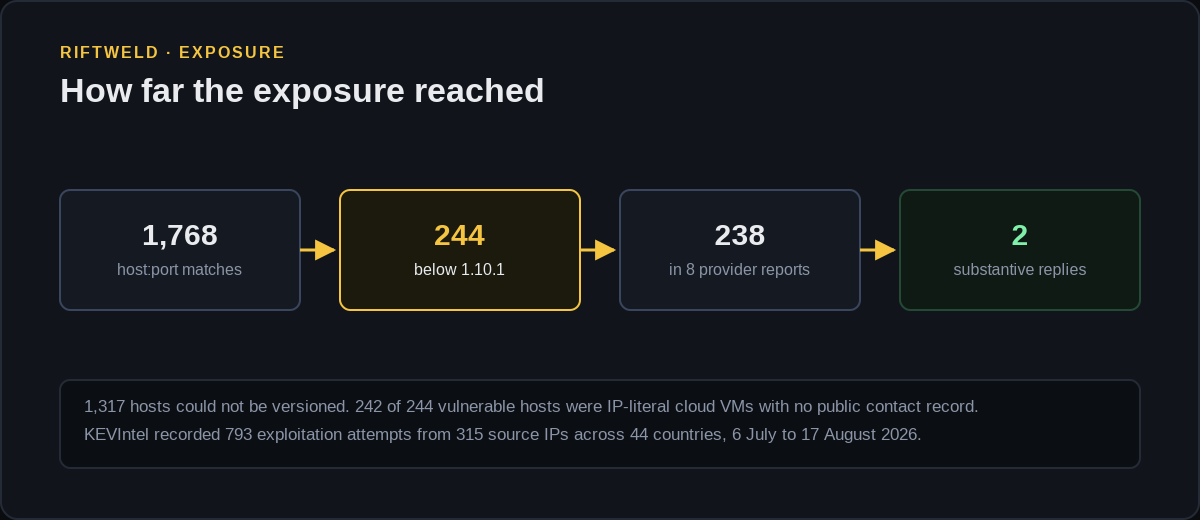
The sweep collected 1,768 host:port matches. Version triage found 244 hosts below 1.10.1, seven patched hosts and 1,317 unresolved hosts. The vulnerable figure is a lower bound: most unresolved hosts timed out or sat behind a firewall and could not be versioned.
The exposed pool was almost entirely IP-literal cloud VMs — 242 of 244 had no identifying domain, certificate or public contact record. Direct owner notification was not possible, so we went through hosting-provider abuse desks. Eight consolidated reports covered 238 hosts, led by 219 on AWS. Two providers responded substantively: Hetzner confirmed the operator's remediation statement and locked the exposed IP, and AWS acknowledged the report and opened an investigation.
One detail from that operator statement matters. Their instance ran a vulnerable version, but auto-login was disabled, so the unauthenticated chain did not apply to that deployment. Version exposure is not the same as exploitability.
In the wild, KEVIntel telemetry recorded 793 exploitation attempts from 315 source IPs across 44 countries between 6 July and 17 August 2026 (methodology). The requests followed the chain directly: auto_login, then validate/code. Exploitation began before the CVE was published, and a public nuclei template followed on 29 July. The attempt count is KEVIntel's sensor measurement, not a census; the CISA KEV listing, IBM's bulletin and independent reporting from Field Effect and Safe Security corroborate that exploitation was real.
What changed in 1.10.1
The fix addresses both halves. Auto-login now issues short-lived access tokens with refresh tokens instead of a year-long superuser key. The code-validation endpoint no longer executes submitted code; the same payload returns empty errors.
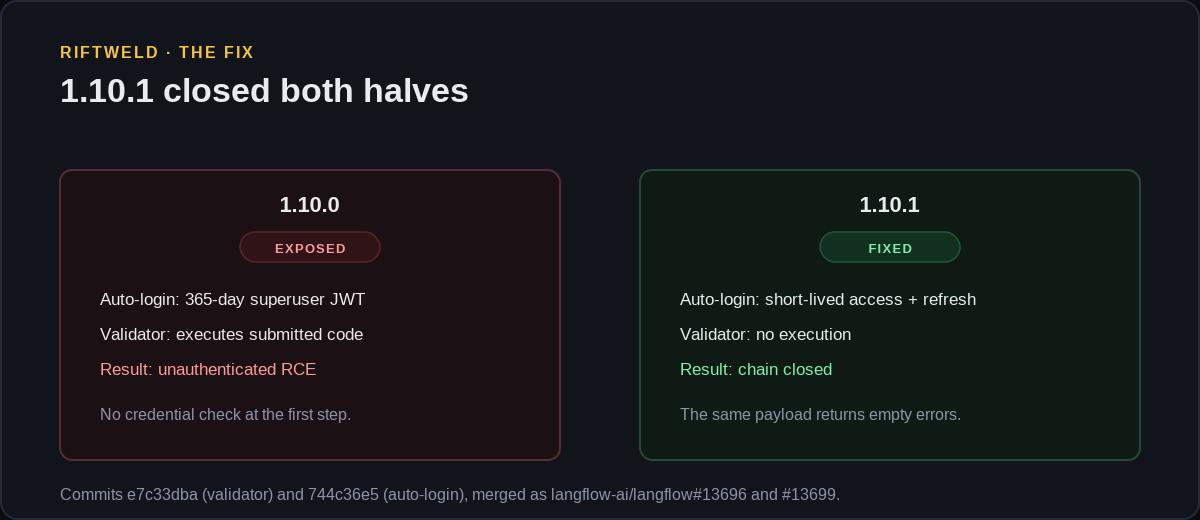
The relevant upstream commits are e7c33dba for the validator and 744c36e5 for auto-login hardening, merged as langflow-ai/langflow#13696 and #13699.
The pattern is familiar. Langflow has shipped default-insecure behaviour before, including CVE-2025-3248, and this class of bug keeps reaching KEV because the defaults do the work for the attacker.
Evidence
- Full technical write-up
- Repository, lab log and captured transcript
- Redacted provider notifications
- IBM advisory
- IBM security bulletin
- NVD entry
- CVE record
- GitHub advisory
- CISA KEV catalogue
- KEVIntel and methodology
- Field Effect analysis
- Safe Security analysis
- SentinelOne entry
- Ionix entry
- Whitehat analysis