An agency patches its Ivanti VPN, runs the vendor’s Integrity Checker Tool, sees green, and closes the ticket. Rapid7 says that green can be wrong.
The patch closes the door. The scan cannot tell you whether someone came through it before you patched.
In this article
Why this matters
Because the patch is the easy half. The hard half is knowing whether the appliance was already compromised when you applied it.
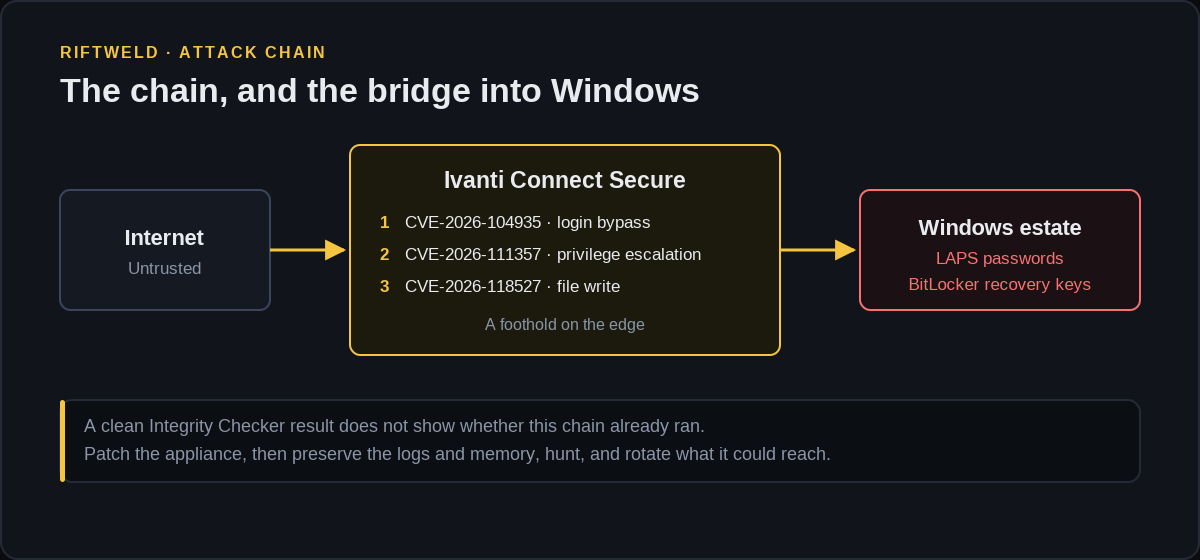
If you run Ivanti Connect Secure, this is not a version-number task. The attackers chained three flaws to get a foothold, raise privilege and write files. Rapid7 found they stole credentials and looked up Windows LAPS passwords and BitLocker recovery keys. Those are the keys that turn a VPN appliance problem into a Windows estate problem. Patching the appliance without rotating what it could reach leaves the intruder a path.
The Integrity Checker Tool is the other problem. It is a tamper check, not a forensic investigation. A clean result is not evidence of absence, and Rapid7 says the observed activity evades it. If you suspect compromise, preserve memory and logs before rebooting, then hunt with Volexity’s indicators and YARA rules.
The chain is also not one gang’s private trick. CISA says each of the later flaws can be chained with the other two. That makes the technique reusable, and it makes the triage requirement more important than the deadline.
For federal agencies, the CISA order sets 2 November for CVE-2026-111357 and 13 November for CVE-2026-118527, and requires an exposure check for each appliance. The dates are a floor. The part that matters is the instruction to look for signs of compromise.
This is the test many incident-response plans fail: the patch is done, but are we clean? If the answer is “the scanner says so,” you do not have an answer.
What happened
On 30 October, CISA added two of the flaws to its list of vulnerabilities known to be exploited in the wild: CVE-2026-111357, with a 2 November deadline for federal agencies and a requirement to check for signs of compromise, and CVE-2026-118527, due 13 November.
Neither was used alone. Attackers chained them with a third flaw, CVE-2026-104935, to break into Ivanti Connect Secure VPN appliances. Ivanti says a limited number of customers were affected. Volexity, which found and reported the activity, says the attackers were preparing to move deeper into victim networks. The operation was stopped, and Volexity says it could not determine the attackers’ final goal.
Rapid7 found that the attackers stole credentials and looked up Windows LAPS passwords and BitLocker recovery keys. Those are the keys that can let an intruder move from the VPN appliance into the Windows estate.
Two things are true at once. The three flaws form a chain by design: CISA says each of the later flaws can be chained with the other two, so this is a property of the vulnerabilities, not one gang’s private trick. And the patch closes the door, but the scan does not tell you whether someone came through it before you patched.
What we know, and what we don’t
| What | Status |
|---|---|
| Two flaws added to CISA’s exploited list on 30 October | Confirmed |
| All three flaws were chained in the wild | Confirmed by Ivanti |
| The actor (UTA0576) was preparing for lateral movement | Reported by Volexity |
| Credentials and recovery keys were targeted | Reported by Rapid7 |
| The attackers moved further or stole data | Not proven |
| How many organisations were affected | Not known |
The first two rows come from CISA and Ivanti. The middle rows come from a single Help Net Security report that draws on Volexity and Rapid7. The bottom rows are gaps.
How the attack worked
The attackers did not need a password.
They sent requests to the VPN appliance that fooled it into skipping its login check, and that let them run commands on the device. This is the break-in: a foothold on a machine that sits between the internet and the internal network.
A foothold is not control. Those commands did not necessarily come with full rights, so the attackers used a second flaw to raise their access from inside the appliance. That step is privilege escalation: turning a limited foothold into higher access, enough to reach parts of the system that should require a stronger check.
The third flaw let them write files to a place they could predict. That is how they could leave attacker-controlled files behind on the appliance, at a path they already knew.
In order: get in without a password, raise limited access to a higher level, then leave files behind. Each step depends on the one before it.
Ivanti’s own timeline explains why the three were not disclosed at once. The company had a fix for the first flaw ready and decided not to delay it when the second was found. The rest were added to the advisory later, as fixes became available.
| Step | Flaw | What it let the attacker do | Severity |
|---|---|---|---|
| 1 | CVE-2026-104935 | Bypass the login check and run commands on the appliance | 8.6 High |
| 2 | CVE-2026-111357 | Raise limited access to a higher privilege level | 8.8 High |
| 3 | CVE-2026-118527 | Write attacker-controlled files to a known location | 4.3 Medium |
CISA says each of the later flaws can be chained with the other two, so the sequence is a property of the vulnerabilities, not one gang’s trick.
Why a clean scan is not proof
Ivanti provides an Integrity Checker Tool, a scan meant to spot tampering on the appliance. The natural response to this advisory is to run it, see green, and close the ticket. Rapid7 says the observed activity evades that tool. A clean result does not rule out compromise.
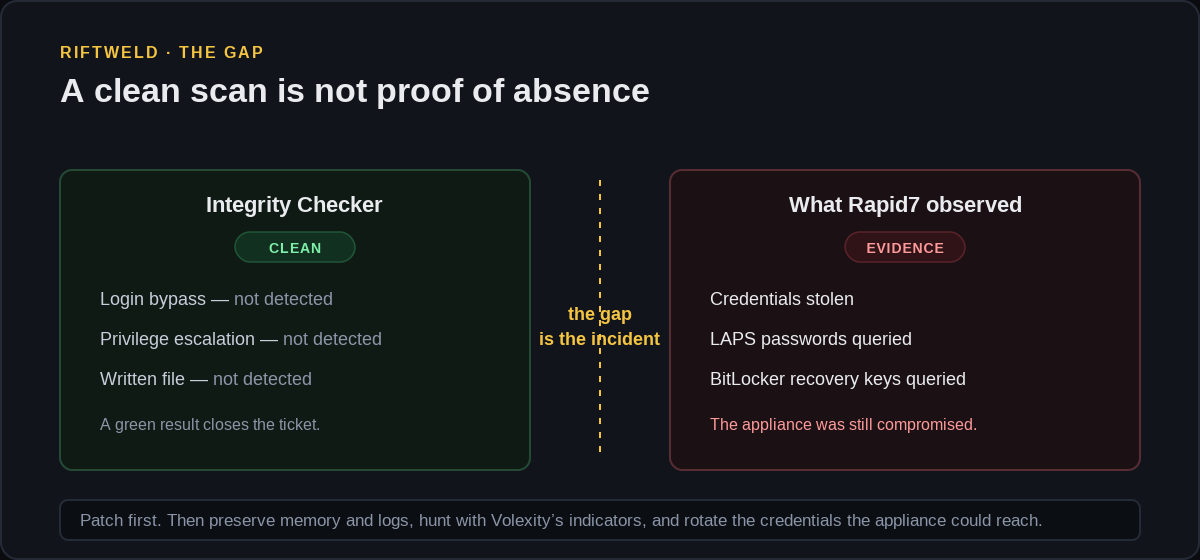
That changes the response. If you suspect compromise, keep the memory and logs before rebooting or resetting where possible, follow Ivanti’s recovery steps, and rotate the credentials the appliance could reach. Ivanti says its own indicators are limited and points customers to Volexity’s published indicators and YARA rules.
For federal agencies, the CISA order also requires an exposure check for each appliance and compliance with BOD 26-04.
What to do
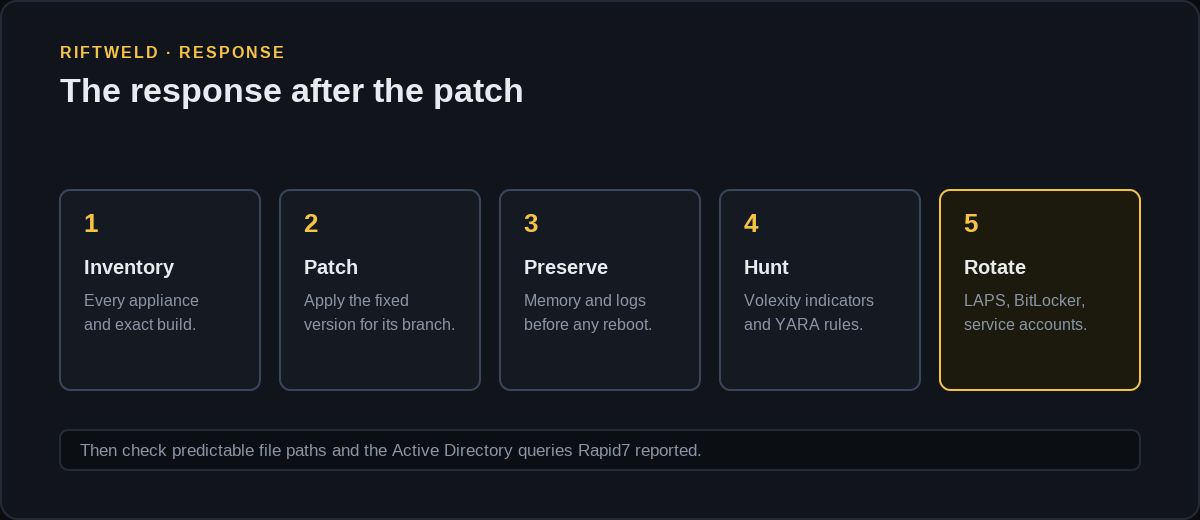
- Find every Ivanti Connect Secure appliance and its exact build.
- Patch to the fixed version for its branch.
- If the 2 November triage deadline for CVE-2026-111357 has passed, treat it as an incident rather than a backlog item. CVE-2026-118527 is due 13 November.
- Keep memory and logs before rebooting, then hunt with Volexity’s indicators and YARA rules.
- Rotate LAPS passwords, BitLocker recovery keys, and service accounts the appliance could reach.
- Look for uploaded files in predictable locations and for the Active Directory queries Rapid7 reported.
| Flaw | Fixed versions | Still affected |
|---|---|---|
| CVE-2026-104935 | 25.1.1.2, 25.1.3.0, 25.1.3.1, 22.8R2.5 | 25.1.1.1 and earlier; 25.1.2.2 and earlier; 22.8R2.4 and earlier |
| CVE-2026-111357, CVE-2026-118527 | 25.1.1.3, 22.8R2.6 | 25.1.1.2 and earlier; 22.8R2.5 and earlier |
22.7 and older are not affected; 25.1.3.0 or later on ISA4500, ISA6500 and ISA8500 are not affected. 22.8 customers should move to 25.1.1.3 or later; 22.8R2.6 fixes all three as an interim step. Both 22.7 and 22.8 reach end of life on 31 January 2027.
What we still don’t know
Whether the attackers moved beyond the VPN, whether they unlocked encrypted disks or took data, how many organisations were hit, when the campaign started, the exact commands they ran, and how the activity evades the integrity checker. We also do not have an independent measurement of that tool’s detection rate.
The point
The patch closes the door. The scan cannot tell you whether someone came through it before you patched. Patching is the fix; the scan is not the proof. Treat the gap between them as the incident.
Method and sources
This piece draws on Ivanti’s advisory, CISA’s exploited-vulnerability list, and Help Net Security’s reporting of Volexity and Rapid7. The flaw mechanics and versions come from Ivanti and CISA. The campaign details are reported by Help Net Security and were not independently verified here.
Sources: Help Net Security · CISA KEV catalog · Ivanti advisory · Volexity · Help Net Security, 14 October · Rapid7